
Topicsトピックス
Walking the Kumano Kodo for the First Time
A Beginner’s Guide to the Nakahechi Route
“I want to walk the Kumano Kodo, but I don’t know where to start.”
If this sounds like you, you are certainly not alone.
There are several pilgrimage routes that make up the Kumano Kodo, but for first-time walkers, we recommend spending a few days on the Nakahechi Route, gradually making your way toward Kumano Hongu Taisha.
Rather than trying to walk too far on your first day, take your time. Let your body get used to the mountain trails and enjoy the journey itself.
Here is a 3-day itinerary we recommend for those walking the Kumano Kodo for the first time.
Day 1 | Takijiri-oji to Takahara

On your first day, we recommend arriving at Takijiri-oji around late morning.
Takijiri-oji is where the mountain walking on the Nakahechi Route really begins.
From here, your first destination is Takahara.
Instead of covering a long distance immediately, this shorter first day gives you time to adjust to walking on the Kumano Kodo’s mountain trails.
Once you leave Takijiri-oji, you will soon find yourself surrounded by the forests and mountains that make the Kumano Kodo so special.
This is very different from walking through a city or a developed sightseeing area. You begin to experience the pilgrimage one step at a time.
When you reach Takahara, be sure to take some time to enjoy the beautiful views of the surrounding mountains.
Spend your first night in Takahara, enjoy a good meal and give your body plenty of time to rest.

Day 2 | Takahara to Nonaka
The following morning, continue from Takahara to Nonaka.
This is a longer day than Day 1, but along the way you can enjoy the forests, mountains and small communities that give the Nakahechi Route its unique character.
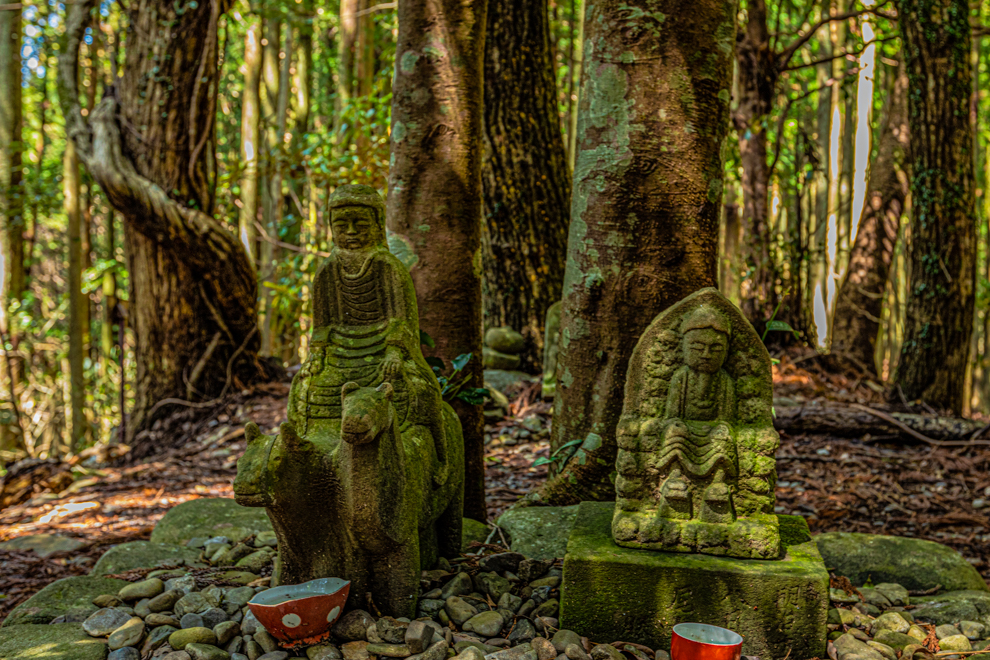

The beauty of the Kumano Kodo is not limited to famous landmarks.
Walking quietly through the mountains, smelling the forest, listening to birds and passing through small rural communities are all part of the experience.
Sometimes, it is these simple moments that remain in your memory long after the journey is over.
When you arrive in Nonaka, eat well and get plenty of rest.
The next morning, you will begin the longest day of this itinerary — the walk to Kumano Hongu Taisha.
Day 3 | Nonaka to Kumano Hongu Taisha
Our guesthouse, Kodo-no-Yado Hiyodori, is located directly along the Kumano Kodo in the Nonaka area.
For first-time walkers, we usually recommend allowing around 8 hours from Hiyodori to Kumano Hongu Taisha.
This is a full day of walking.
At Hiyodori, our guests have breakfast in the morning and take a lunch box with them before setting out toward Kumano Hongu Taisha.
Eight hours may sound like a long time, but there is no need to rush.
Walking the Kumano Kodo is not simply about reaching your destination as quickly as possible.
The scenery, history, forests and quiet moments you experience along the way are an important part of the pilgrimage.
Three Mountain Passes — Be Especially Careful on the Descents
The trail between Nonaka and Kumano Hongu Taisha includes three mountain passes, so you should expect plenty of ups and downs.
For beginners, there is one thing we especially want you to remember:
Be careful on the downhill sections.
Many people naturally think that climbing uphill will be the hardest part.
However, after walking for several hours, your legs become tired. On a descent, wet stones, tree roots and fallen leaves can make the trail slippery.
We have seen walkers lose their footing on downhill sections, particularly later in the day when they are tired.
So when your legs begin to feel tired, slow down.
The more tired you are, the more carefully you should walk downhill.
Give yourself plenty of time and enjoy the trail at your own pace.
Doyukawa — A Village That Disappeared into the Mountains
One place we would especially like you to notice along this section is Doyukawa.
Today, it is a peaceful place surrounded by nature, but people once lived here in a small mountain community.
Doyukawa village was abandoned in the early Showa period.
As you walk through this quiet area today, traces of the people who once lived in these mountains remind us that the Kumano Kodo was never simply a hiking trail.
Pilgrims travelled along these paths, while local people lived and worked beside them.
When you pass through Doyukawa, take a moment to imagine what life in these mountains may once have been like.

Your First View of the Great Torii Gate of Oyunohara
As you get closer to Kumano Hongu Taisha, there is a short detour that we highly recommend.
From the mountains, you can look out toward the enormous torii gate of Oyunohara.
After spending hours walking through the mountains, seeing the great torii gate in the distance can be a special moment.
You may find yourself thinking:
“I walked all the way there.”
Seeing Oyunohara after reaching the area by car or bus is one experience.
Seeing it after travelling through the mountains on your own two feet is something quite different.
That feeling is one of the rewards of walking the Kumano Kodo.

Discover the Beauty of Japan’s Mountains
The Kumano Kodo has many historical sites and famous viewpoints.
But these are not the only things we hope you will discover.
Deep forests.
Clear mountain water.
Moss-covered stones.
Birdsong.
Trees changing with the seasons.
And the small creatures that live quietly in the forest.
The Nakahechi Route is incredibly rich in nature.
For visitors from overseas in particular, we hope walking the Kumano Kodo gives you an opportunity to experience a side of Japan that is very different from its cities and famous tourist destinations.
There is something special about the mountains of Japan, and sometimes the best way to understand that is simply to walk through them.


If It’s Your First Kumano Kodo, Take Your Time
For first-time walkers, this is the itinerary we recommend:
Day 1: Takijiri-oji → Takahara
Stay overnight in Takahara
Day 2: Takahara → Nonaka
Stay overnight in Nonaka
Day 3: Nonaka → Kumano Hongu Taisha
You do not need to walk huge distances every day.
Walk slowly.
Look at the mountains.
Listen to the forest.
Stop when you are tired.
When you arrive at your accommodation, eat well and sleep well.
Then wake up the next morning and begin walking again.
We believe this is one of the best ways to experience the Kumano Kodo.
At Kodo-no-Yado Hiyodori, we also do our best to help our guests prepare for the next day’s walk, including advice about the weather, trail conditions and what time to leave in the morning.
Whether you are an experienced hiker or walking a pilgrimage trail for the first time, we hope that when you finally reach Kumano Hongu Taisha, you can look back on your journey and simply think:
“I’m glad I walked the Kumano Kodo.”
In our next article, we will introduce what to pack for walking the Kumano Kodo in each season, including clothing, rain gear and other useful items.
Kodo-no-Yado Hiyodori